Wondering if you need a website for your business?
The short answer: yes.
The long answer? We explain it to you in the lines below.
Whether you're at the beginning of your journey or already have a business operating offline, a professional websiteIt is one of the most important investments you can make. In a world where almost all buying decisions start with a Google search, the lack of a website can completely take you out of the competition.
This guide is dedicated to entrepreneurs looking for answers to questions such as:
“How can I make a website for myself?”, “What options are there?”, “Is it worth investing in an agency?”
We will analyze the best options according to your budget, available time and business goals.
Without an online presence, you are invisible. In 2025, more than 75% of customers search for information online before making a purchase decision. If I can't find you, I choose the competition. A website is your digital office — the place where you present your services, attract customers and generate trust.
If you have decided that you need a website, the next step is simple in theory: build it yourself or collaborate with professionals.
This variant looks attractive to many small businesses, especially for budget reasons. You have platforms such as:
In a nutshell:if you have a minimum budget, time and patience, you can start on your own. But your site will most likely have Visible limitationsin SEO layout, functionality and performance — things that can directly affect your image and business results.
If you want real results, speed, scalability and a Website optimized for conversions, collaboration with an agency is the ideal choice.
What does a specialized agency like 247Web offer you?
Of course, working with an agency involves a bigger budget than a Wix subscription, but the benefits are long-term: more traffic, a professional image, and a trusted partner that grows with your business.
If you have chosen to create your own website, it is important to be aware of the pitfalls that many early-stage businesses fall into. Although a website may look “ready” after a few hours of work on a drag-and-drop platform, in reality there are many details that make the difference between an amateur site and one that generates real results.
Your first instinct is to load your homepages with everything you know you have to offer — but most of the time, a cluttered design loses your visitor, not convinces them. Without a clear hierarchy of information, the user will not know where to click or what to do next.
A website must have a goal: sales, lead generation, contact, etc. Many entrepreneurs do not establish from the start which is the main action they want from the user. Without clear buttons, call-to-actions and a logical structure, the site will not convert.
In 2025, over 65% of web trafficcomes from mobile. Free templates are not always responsive, and a site that loads hard or looks chaotic on your phone cuts your chances from the startto success.
Using large images, unnecessary plugins, or poorly coded themes can lead to a long charging time. Google penalizes this, and users... leave. Approx. 40% of people abandon a website that loads in over 3 seconds.
Just because you launched a site, doesn't mean it will be visible on Google. The lack of meta-tags, correct URLs, logical content structure, and internal links seriously affects your chances of appearing in relevant results. Many site owners do not know that they need to link the site to Google Search Consoleor upload a sitemap.
If the site does not look good or does not look professional, does not inspire confidence. This is why many customers give up after the first page. An outdated design, hard-to-read fonts or poor-quality images can do more harm than good.
A website made “on the run” may seem like a good shortcut initially, but in the long run it will consume more time, money and lost customers. That's why working with a specialized team can make the difference between a site that just exists... and one that just exists... brings results.
A website isn't just a beautiful page online — it's your digital business card, your 24/7 salesperson, and sometimes your first contact with a new customer. Here's what should not be missing:
Your website must have a clear hierarchy of information. From the first second, the user should understand who you are, what you offer and what you want to do next: buy, contact you, find out more. Without this flow, the site becomes just a lost page on the internet.
Over 60% of users will access the site from their phone. A professional website should look flawless on any device, be it desktop, tablet or mobile. In addition, navigation should be intuitive — no complicated menus or hidden buttons.
Slow sites mean lost users. A charging time under 3 seconds is no longer a “luxury”, but a minimum standard. It uses optimized images, clean code, and high-performance hosting to keep visitors from losing before they see the content.
Texts should be written for humans, not robots. But that doesn't mean SEO should be ignored. A balance between useful information, keywords, and clear expression helps both indexing on Google, as well as when converting visitors into customers.
Don't leave users wondering “what's next?” Explain to him: “Ask for an offer”, “Schedule a meeting”, “View Portfolio”. Placing these buttons at key points of the site is critical to results.
Reviews, partner logos, completed projects, certifications — all contribute to Building trust. If people see that you have worked with others before and are getting results, they are more willing to contact you.
A website without SEO optimization is like a store in the middle of the wilderness. Make sure each page has meta descriptions, relevant titles, header structure, sitemap, and internal links — things that are essential to appear on Google.
If you check these items, you already have a solid foundation for an effective website. And if you don't know where to start, an experienced team can guide you step by step so that your investment is a truly profitable one.
Many entrepreneurs at the beginning want to make their website “self-directed” — which is not necessarily wrong. But once your business starts to grow, you need a solid partnership to support that growth.
Time spent in tutorials can be invested in strategy, partnerships or sales. An agency takes all the technical details off your shoulders, so you take care of what really matters: your business.
It's not just about “how it looks”, it's about how it works. A site created by specialists is built around your business goals and has UX research, SEO strategy and current technology behind it.
A serious agency doesn't just deliver you a website, it offers you reports, A/B testing, performance analysis, maintenance, SEO or Google Ads campaigns — all synchronized to attract more customers.
The logo, the colors, the fonts, the tone of the messages — all should be consistent on the site, in social media, in print materials or in promotional campaigns. Only a multidisciplinary team can give you this complete control over your image.
A website made wrong means a loss of money. Whether it's bugs, slow speeds, lack of indexing in Google, or simply a poor user experience — they can all seriously affect customer trust in your business.
💡 In a nutshell: If your business is more than just a hobby, it's worth investing in a professional website, created by people who do it day in and day out and know exactly what works and what doesn't.
One of the most frequently asked questions is: “How much does a website cost?”The answer is simple, but not necessarily satisfactory: depends.
The cost of a website varies enormously depending on the complexity, purpose, platform chosen and, above all, who creates it.
If you choose to make your website yourself, the initial costs may seem small.
However, don't forget to add to the tally:
🟡 Disadvantages: limited functionality, performance issues, SEO risk, generated look on template.
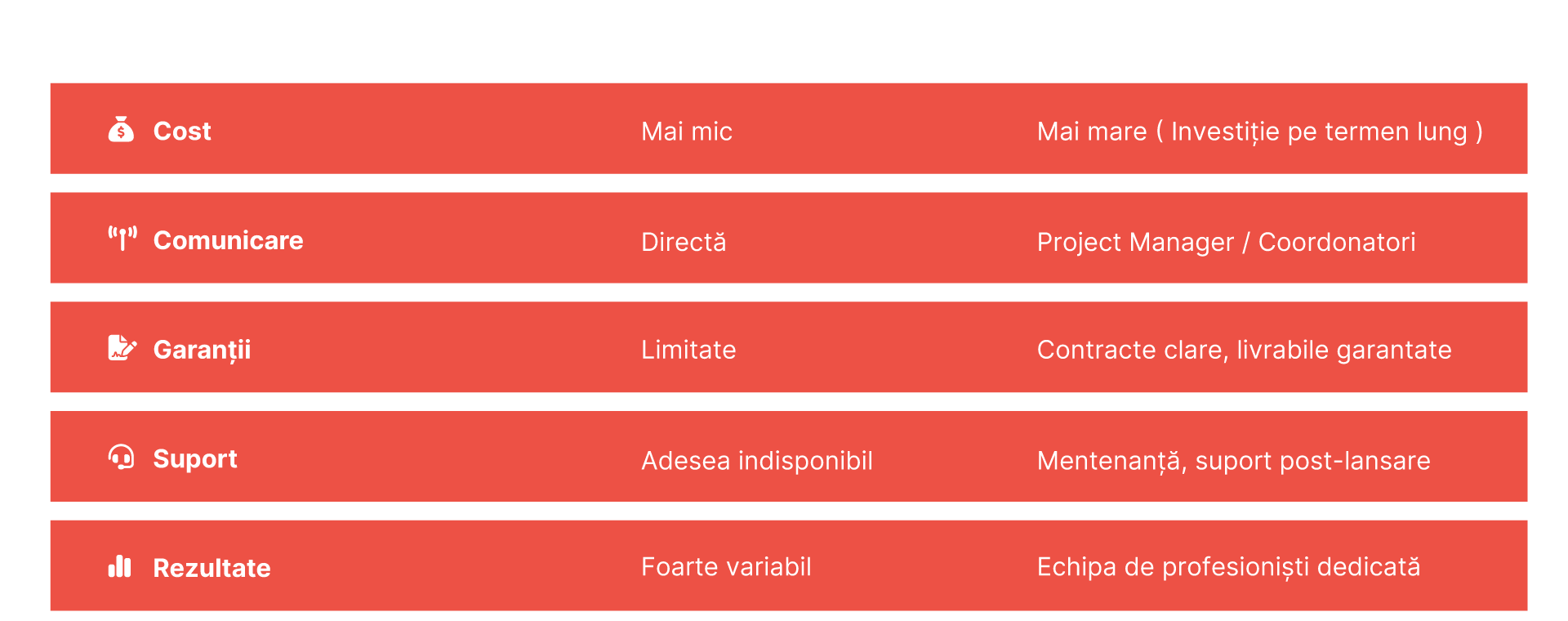
A good freelancer can deliver a decent, personalized website, but with some limitations in the area of technical support, SEO strategies or marketing integration.
✔️ Good for: simple projects, presentation sites.
🔴 Limits: lack of a dedicated team, lack of maintenance or overall strategy.
If you want your website to make a real impact, convert and grow alongside your business, partnering with an agency is the safest choice.
🔵 What you get:
A wrong choice at the stage of building the site can cost time, money and customers. For this reason, it is essential to work with someone who understands goals of your businessand can translate them into effective digital solutions.
✅ Real Portfolio
Do you have access to clear examples of previously delivered projects? Whether it's a freelancer or agency, ask for examples from your industry.
✅ Clear working process
Avoid unstructured collaborations. A professional team has a well-defined process — from research to design, development and testing.
✅ Transparency in communication
Communication is essential. If I answer hard at first, use jargon, or avoid essential questions, it's a warning sign.
✅ Support & Maintenance
A site does not end on the day of launch. You need someone who can also provide support after publication, whether it's bugs, updates or small changes.
✅ Expertise in SEO and Performance
A nice site that doesn't show up on Google... it's not very useful. Make sure your team has solid knowledge of on-site SEO optimization and upload speed.
Many entrepreneurs believe that once the site is published, the job is done. In reality, the launch is just the beginning.
You need:
A site that is constantly evolving will remain relevant in the eyes of Google and its users.
If you've come this far, you've already understood that a website is not just a beautiful page on the internet. It is a strategic tool that can generate customers, strengthen the brand and grow exponentially.
You can start simple. The important thing is to start correctly.
And if you don't want to waste time, energy and opportunities, let us help you.
👉 Contact us herefor a personalized offer.